Destiny 2's Lightfall Three Years Later: The Expansion That Almost Derailed Everything
Lightfall's campaign turned the Veil and Witness into unexplained macguffins, leaving players baffled.
I still remember the cold disbelief that washed over me after the final mission of Lightfall back in 2023. Even now, in 2026, with The Final Shape behind us and the Light and Darkness saga finally complete, that eight-hour campaign feels like a fever dream I can’t shake. Bungie had spent years moving pieces on a cosmic chessboard, and Lightfall was supposed to be the beginning of the end—the Infinity War of Destiny. Instead, it was a glorified tutorial for Strand that left me with more questions than answers about the Veil, the Witness, and why any of us were even on Neptune.
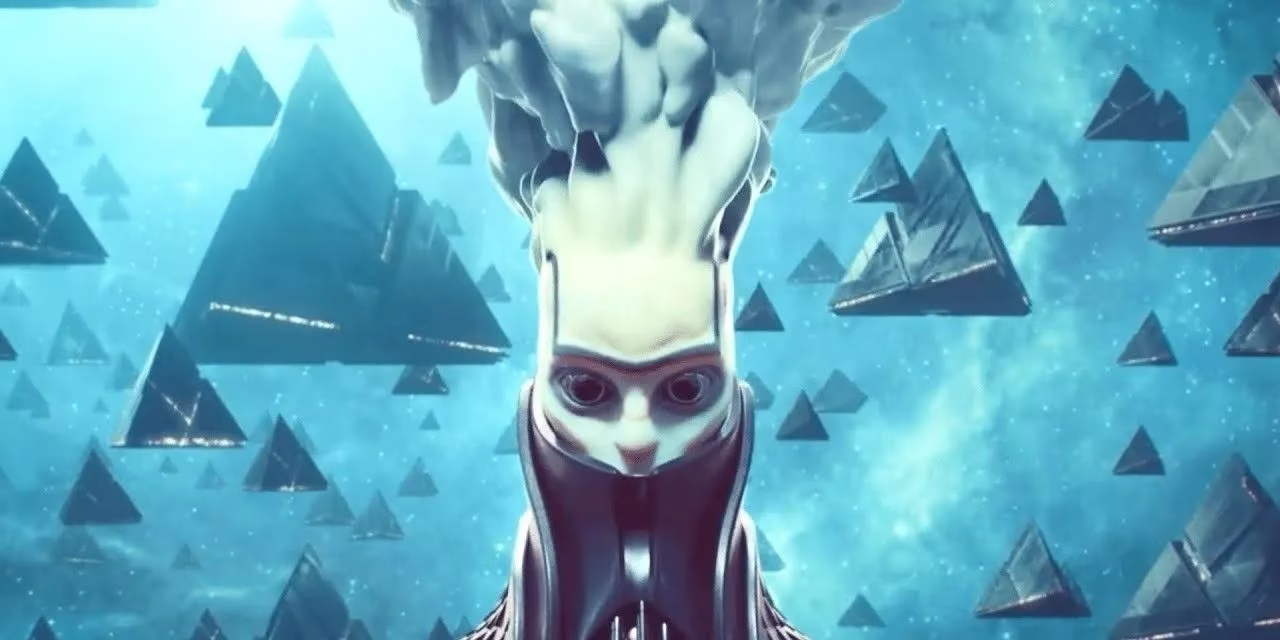
Let’s rewind. The hype train before Lightfall was absolutely bananas. After The Witch Queen—a masterclass in video game storytelling that dug deep into Savathûn’s past and made us question everything about the Traveler—the community was frothing at the mouth for the next chapter. The Witness was finally stepping out of the shadows, a terrifying, smoke-headed deity with the swagger of a cosmic accountant. The opening space battle against the Black Fleet was pure adrenaline, a visual spectacle that had me screaming at my monitor. Sneaking onto an enemy ship with Osiris to crash-land on Neomuna felt like the start of something legendary. Little did I know that the campaign would quickly devolve into a narrative train wreck.
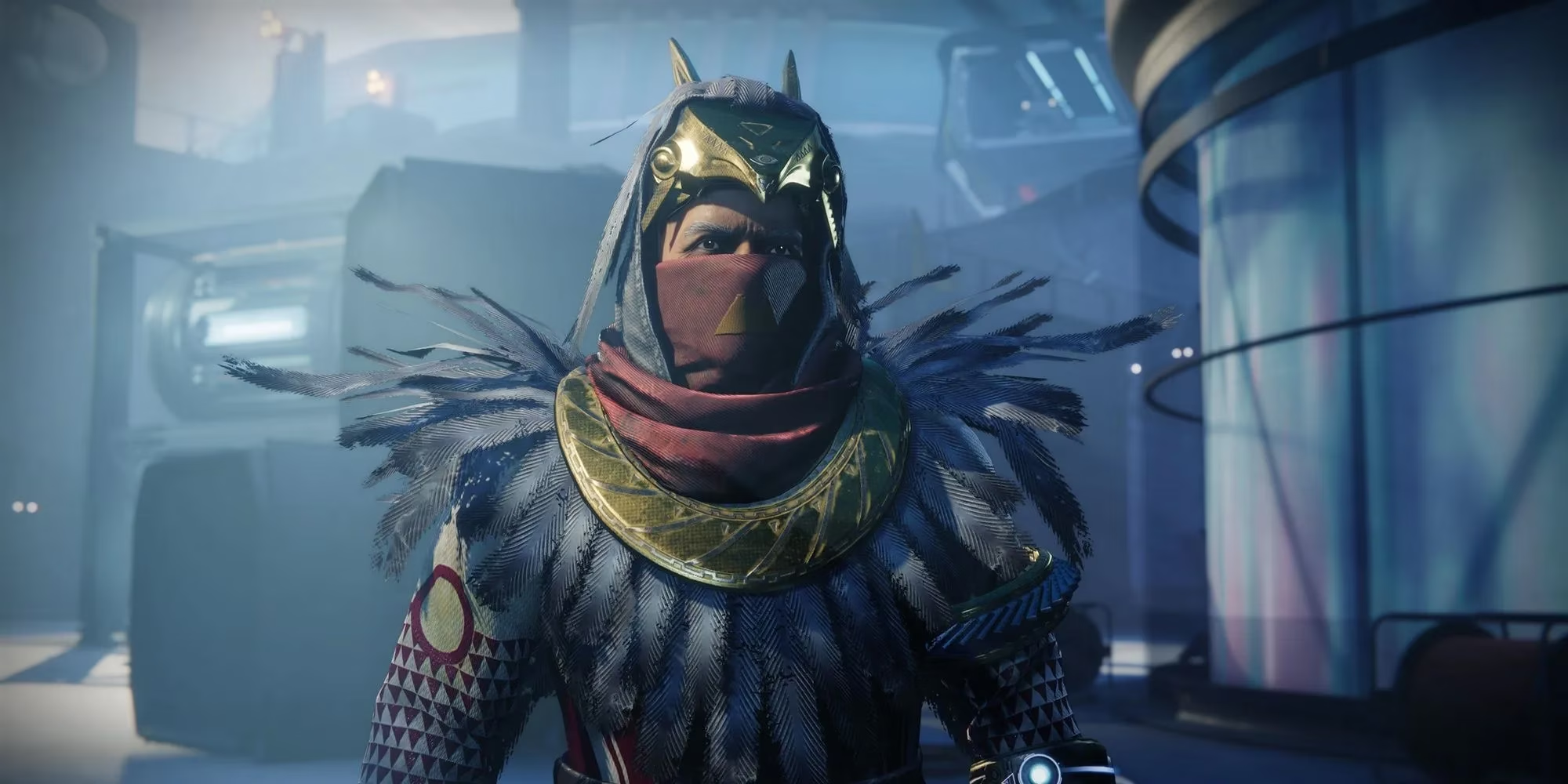
Neomuna itself was a neon-drenched ghost town with a virtual population and a mysterious power source called the Veil. The Cloud Striders, our new pals on the block, were supposed to be the cool kids who knew all the secrets. But from the moment we met them, it was like pulling teeth to get any straight answers. What is the Veil? Why does the Witness want it? How does it connect to the Traveler? The game practically looked me in the eye and said, "Don't worry about it, just punch Calus." And that’s not hyperbole. Our own ghost, who usually can’t shut up about paracausal energy readings, suddenly became a mute when it came to the big questions. Even Osiris, the guy who should have been screaming for answers about the macguffin that could end the universe, was instead laser-focused on mastering Strand. It was as if the entire cast had been hit with a collective case of amnesia, and I was the only one in the room pointing at the elephant.
The Witness gets the Veil, does something confusing to the Traveler, and Commander Zavala declares the Traveler "gone" based on what felt like a bad vibe. No one explained how he knew that, and no one has ever explained it well since. That was the core problem of Lightfall: it treated its central mystery like a hot potato nobody wanted to hold. Even in 2026, after dozens of lore entries, seasonal stories, and The Final Shape itself, the Veil remains a weird, ill-defined energy blob that some Neomuni probably used to toast bagels.
And then there’s Strand, the neon-green ability that became the campaign’s real main character. Don’t get me wrong, swinging through the city like Spider-Man was a blast, and tangling up Hive with threads never got old. But the way the story shoved it down our throats was as subtle as a Titan eating a box of crayons. Osiris kept telling us that Strand was the key to defeating Calus because the emperor had prepared for all our other powers—which, by the way, is a hilarious excuse when you remember that Calus is basically a giant roly-poly with a god complex. The entire campaign hinged on suppression beacons that made all our existing builds useless, forcing us to master Strand just to progress. It felt less like a narrative beat and more like a heavy-handed tutorial designed to sell the new subclass. Even now, when I equip Strand in The Final Shape’s endgame, a little voice in my head whispers, "Remember when this ability was more important than the literal fate of the Traveler?" Not my proudest Guardian moment.
What made the whole thing sting so badly was the contrast with The Witch Queen. That expansion had everything: shocking twists, emotional gut punches, and a villain who made us question our own righteousness. It set a new bar, and every season after it walked us closer to the inevitable collision with the Witness. Lightfall should have been the payoff, the moment where the curtain was pulled back and the stakes were set in stone. Instead, it was like watching Thor forge Stormbreaker in a vacuum while Thanos quietly snapped his fingers off-screen.
Now, sitting here in 2026, I have to give credit where it’s due. Bungie eventually patched some of those narrative wounds. The seasons that followed Lightfall—Defiance, Deep, Witch—did a lot of heavy lifting, slowly piecing together the Veil’s purpose and the true nature of the Traveler’s silence. And The Final Shape, while not perfect, managed to stick the landing in a way that gave me goosebumps. But that doesn’t erase the fact that Lightfall was a momentum killer, a campaign that utterly deflated what should have been the franchise’s highest moment. Player numbers skyrocketed during Lightfall’s launch, and they cratered just as quickly when the story failed to deliver. It was a lesson in how not to handle a decade-long narrative build-up.
Looking back, Lightfall is the expansion that taught me to lower my expectations, even when a developer has earned all the good will in the world. It remains a bizarre, fun-but-hollow detour in Destiny’s history—proof that even Braid-obsessed game designers can occasionally drop the ball harder than a Cabal drop pod. If you’re a New Light joining us now, you’ll probably play Lightfall, enjoy the Strand power fantasy, and wonder what all the fuss was about. But for those of us who were there, who waited years for answers, it will always be the chapter where we almost lost our Destiny.