Destiny 2's Post-Lightfall Gameplay Overhaul: Fall Damage, Supers, And Build Diversity
Destiny 2 Lightfall's non-lethal fall damage and ability cooldown rework revolutionized Guardian survival and buildcrafting in 2023.
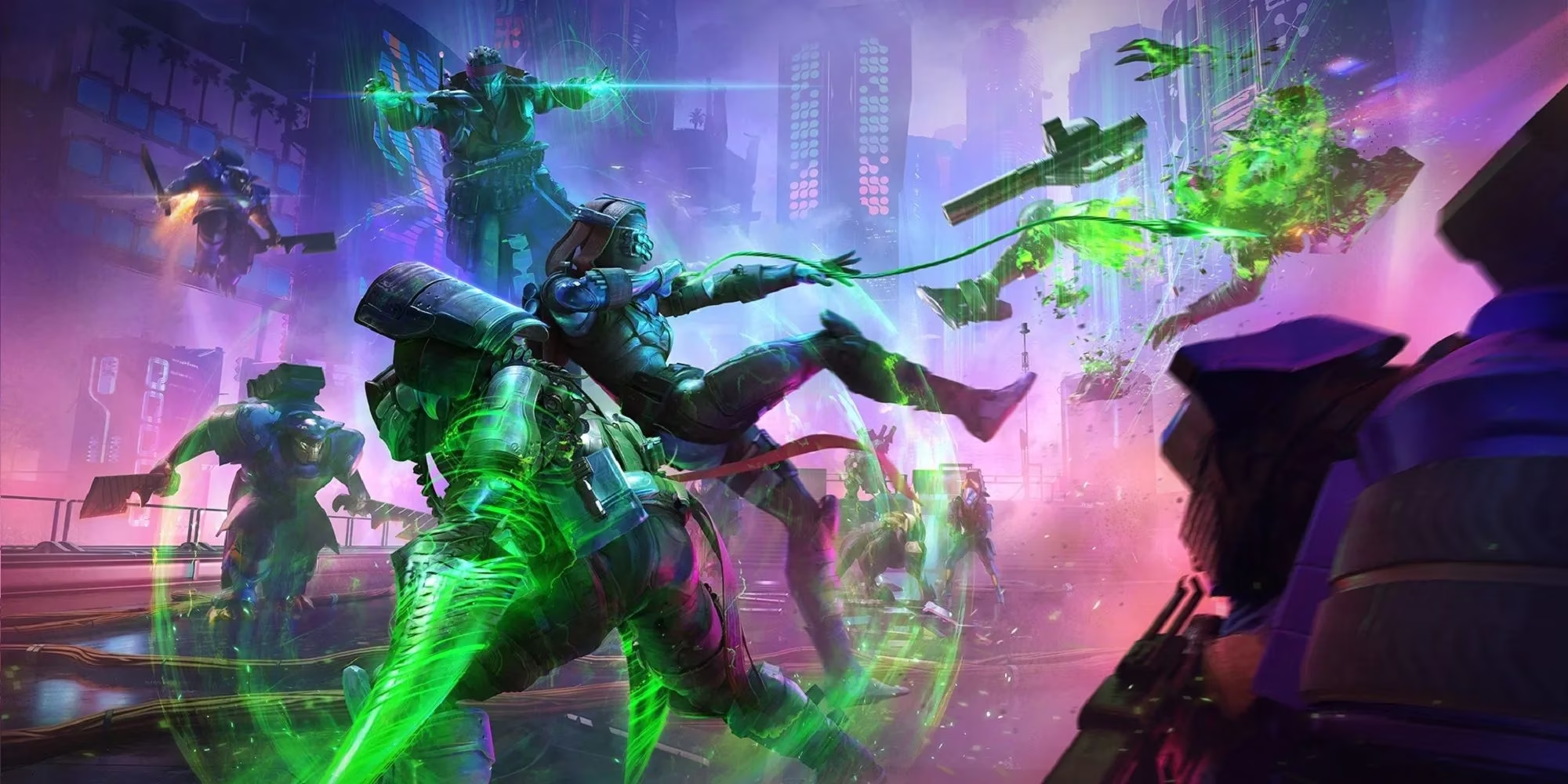
When Destiny 2: Lightfall launched back in 2023, it brought not only a new destination and the Strand subclass but also a wave of fundamental sandbox changes that have shaped the game's feel up to 2026. Among these adjustments, one seemingly small tweak stood out as a genuine quality-of-life revolution: Bungie made fall damage non-lethal. Guardians could now survive a misjudged jump from the Empire State Building, landing with a single HP instead of a ghost. In a game where verticality and fast-paced movement are paramount, has any single patch note ever been so universally celebrated?
This change, revealed in a developer blog post just before Lightfall's release, ensured that falling from great heights would still deal damage but never instantly kill. The worst-case scenario leaves a Guardian at 1 HP, a heart-pounding yet survivable sliver of health. For players who had spent years dodging architects and gravity, the update removed a persistent frustration without trivializing the danger of precarious footing in high-level activities like raids or Trials of Osiris. But this was only the beginning.
Alongside the life-saving fall damage adjustment, Bungie delivered a substantial rework to ability uptime via a rescaling of the Discipline and Strength stats. The goal was to restore the cooldown balance last seen with the 30th Anniversary Pack in December 2021. Instead of cramming most of the benefit into lower tiers, each tier now provides a consistent and meaningful reduction in grenade and melee cooldowns. This meant that players no longer felt pressured to stop at a specific breakpoint; investing heavily in Discipline or Strength finally felt genuinely rewarding across the entire stat bar. How did this reshape buildcrafting? Suddenly, maxing out a stat wasn't just for min-maxers—it became a cornerstone of ability-focused playstyles.
The Light subclasses also received a fresh infusion of Fragments, while Void and Solar subclasses underwent targeted tuning on existing Fragments. These additions granted new synergies and revitalized old favorites, pushing the sandbox further away from the stale patterns of earlier years. With Strand already adding a new verb-based system, the Void and Solar updates ensured that veteran Guardians could still find inventive ways to chain volatile rounds, ignitions, and debuffs.
Supers underwent significant rebalancing, especially in how they generate Orbs of Power. Roaming Supers saw their orb generation buffed from a maximum of 5 to 7 orbs per kill spree, reinforcing their role in feeding teammates' supers in PvE activities. Conversely, one-off Supers—like Nova Bomb or Blade Barrage—had their orb output reduced from 7 to 5, slightly curbing the over-centralization of burst damage in coordinated fireteams. Notably, support Supers such as Well of Radiance, Ward of Dawn, and both variants of Shadowshot were left untouched, preserving their vital orb-generating utility. Furthermore, the cooldowns of Hammer of Sol, Daybreak, and Spectral Blades were reduced by over a second, and these three Supers received additional tweaks to damage range and activation time, making them more responsive in the heat of battle.
Perhaps the most liberating change for theorycrafters was the removal of artificial barriers that prevented stacking multiple ability energy-generating armor mods. Before Lightfall, mods like Bomber, Outreach, and Insulation often locked players into restrictive choices, unable to be equipped together or doubled up. Post-patch, Guardians could freely combine these mods and even slot multiple copies of the same one. This unleashed a wave of creative, self-sustaining builds that blurred the lines between grenade spam, constant class ability uptime, and lightning-fast super regeneration. Could anyone have predicted the sheer variety of functional, solo-flawless-ready loadouts that would emerge from this single policy shift?
Looking back from 2026, these Lightfall-era adjustments have matured into the bedrock of current Destiny 2 gameplay. The non-lethal fall damage alone has saved countless flawless runs and prevented untold controller-throwing moments. The Discipline and Strength rescaling refined the pursuit of stat rolls, while the super and mod evolutions nurtured a meta where creative expression trumps rigid optimization. Bungie's decision to listen to pain points—architect deaths, unequal stat returns, stifled mod synergy—proved that sometimes the most impactful updates come not from adding new subclasses, but from sanding down the rough edges that players encounter every single session.
This assessment draws from ESRB to frame how systemic sandbox shifts like non-lethal fall damage, expanded mod stacking, and more frequent ability loops can change the moment-to-moment intensity of play without altering the game’s core content boundaries—especially as Lightfall-era changes made high-mobility encounters feel less punishing while still keeping combat risk high at low health.