Destiny 2's Vesper's Host Dungeon: A Roll Controversy and the Perk Proximity Theory
Destiny 2's Revenant Episode and the VS Chill Inhibitor grenade launcher ignite heated debate on RNG, perk-weighting, and player trust.
Destiny 2's Revenant Episode was a critical moment for the game, arriving when player morale was still recovering from the turbulence following The Final Shape. While the episode's content was generally well-received, its story was considered by many to be a bit brief. The true high point, however, was the release of the Vesper's Host Dungeon. Guardians widely praised its design, and excitement soared over a powerful new heavy grenade launcher, the VS Chill Inhibitor. Yet, this very weapon became the center of a growing storm within the community. A specific, highly coveted perk combination seemed frustratingly elusive, leading to accusations, theories, and a renewed debate about Destiny 2's legendary random number generator (RNG).
The Coveted Roll and the Rising Fury
What made the VS Chill Inhibitor so special? It's a rapid-frame heavy grenade launcher, a weapon type prized for dealing massive burst damage to bosses. The roll that sent the meta into a frenzy combined Envious Arsenal with Bait and Switch. This combination promised unparalleled damage potential, instantly making it a top-tier choice for any serious Guardian. Players flocked to the Vesper's Host Dungeon, specifically farming the first encounter, Activation, where the weapon drops.
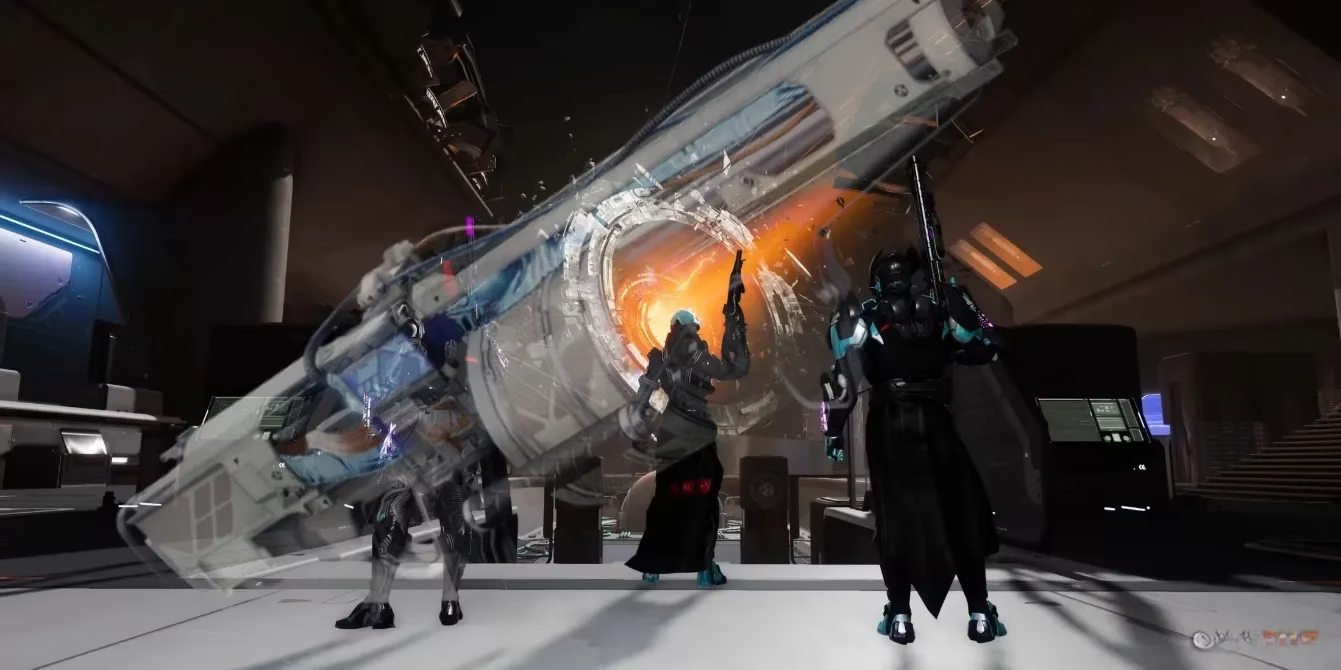
But the excitement quickly turned to frustration. After a weekend of intense farming, a significant number of players reported coming up empty-handed. This wasn't just typical bad luck; it felt systemic. The community's suspicion crystallized into a specific accusation: perk-weighting. Was Bungie intentionally lowering the drop chance for this god-roll combination? Faced with these claims, Bungie issued a firm statement: there is no perk-weighting in the game. Yet, the evidence from the player base seemed to tell a different story.
The Data and the Binomial Test
Enter a Guardian named Spark. Skeptical of the official line, they decided to apply some statistical analysis to the problem. Using a binomial test on collected drop data, Spark attempted to calculate the probability of the Envious Arsenal + Bait and Switch roll occurring naturally. Even acknowledging potential flaws in their data-gathering process, the results were striking. The test suggested the likelihood of this specific combo dropping was incredibly low—so low that it pointed toward something more than mere chance.
This wasn't the first time players had questioned the fairness of perk distribution. Destiny 2's RNG for non-craftable raid and dungeon gear has always been a point of contention. But this felt different. With a weapon so powerful at the top of the meta, the stakes for players' time investment were higher than ever. If the system wasn't working as intended, it represented a significant breach of trust. So, if it wasn't intentional weighting, what could it be?
The Perk Proximity Theory: A New Suspect
Another fan, Vendetta, proposed an alternative explanation that has gained considerable traction: the "Perk Proximity Theory." This theory doesn't accuse Bungie of malicious weighting. Instead, it suggests a potential bug in the loot generation code. The idea is simple yet profound: perks might be more likely to roll in combination with another perk that is adjacent to them in the same column on the weapon's perk grid.
Think of it like this:
| Perk Column 3 | Perk Column 4 |
|---|---|
| Envious Arsenal | Danger Zone |
| Chain Reaction | Bait and Switch |
| Vorpal Weapon | Cascade Point |
| Clown Cartridge | Explosive Light |
According to the theory, Envious Arsenal (top of Column 3) would have a higher chance to pair with Danger Zone (top of Column 4) because they are "close" in the grid layout. Conversely, pairing Envious Arsenal with Bait and Switch (which is several slots down in Column 4) would be statistically rarer due to the "distance" between them. This would explain why players might see streaks of similar, less-desirable rolls and why the meta god-roll feels like chasing a ghost.
Strengths and Weaknesses of the Theory
The Perk Proximity Theory resonates with players because it offers a testable, logical framework for the observed anomaly.
Why it makes sense:
-
It explains anecdotal patterns of "clumped" perk drops.
-
It provides a mechanical reason for specific combos being rare without assuming intent.
-
Players can manually log their own drops and compare them to the perk grid on databases like light.gg to gather evidence.
Where it faces challenges:
-
Data Collection is Hard: When a weapon is dismantled in-game, its specific roll often vanishes from public tracking databases. Building a large, reliable dataset requires manual, community-wide effort.
-
It remains a theory until Bungie confirms or denies the underlying code behavior.
The Stakes: Time, Trust, and the Future
Why has this issue sparked such a major controversy? The answer lies in the value of a Guardian's time. Farming a dungeon encounter repeatedly is a significant investment. To suspect that time is being wasted due to a hidden bug—or worse, an intentional throttling of rewards—is a serious matter of trust. Players have invested countless hours into Destiny 2, and the expectation is that the time spent is rewarded fairly. The new theory suggests that the reward mechanism itself might be flawed.
The community now faces a dilemma. Do they continue farming, hoping that sheer persistence will eventually yield the desired result? Or do they wait for Bungie to investigate the claims? The ball is in Bungie's court. A follow-up investigation is needed—one that goes beyond the initial denial. The company has a history of addressing community concerns, and the current situation is no different. The outcome will determine the future of Destiny 2's gameplay.
Conclusion: The Future of Destiny 2's Gameplay
It's a familiar story in the world of online gaming: the pursuit of the ultimate goal is a journey fraught with challenges and rewards. The controversy surrounding the VS Chill Inhibitor roll is a symptom of a larger issue: the nature of reward systems in online gaming. The Perk Proximity Theory offers a plausible explanation for the observed anomaly, but it also raises questions about the future of Destiny 2's gameplay.
The community is now in a position where it must navigate the complexities of game design and the psychology of reward. The VS Chill Inhibitor roll is a test case for the game's ability to adapt and evolve in response to player feedback. The outcome will likely have a lasting impact on how future content is designed and how rewards are structured. As the game continues to evolve, the lessons learned from this episode will shape the future of Destiny 2's gameplay, ensuring that the pursuit of perfection remains a rewarding and engaging journey for all.