How Strand Redefined Fun in Destiny 2 Beyond the Meta
For a number-crunching Guardian, Destiny 2's Strand subclass from Lightfall unleashed responsive chaos over damage.
For years, he played Destiny 2 like a mathematician with a gun. His vault overflowed with god rolls, his loadouts were tuned to the decimal place, and his only metric for success was the cold, hard number floating above a dead champion. He had a Solar Hunter build so dialed in that Young Ahamkara’s Spine might as well have been welded to his arms. Tripmines and knives flew with such ruthless efficiency that Nightfalls started to feel like target practice. On Void, Gyrfalcon’s Hauberk turned him into an invisible typhoon of volatile rounds—endless stealth, endless explosions, endless safety. Stasis and Arc? They gathered dust. Why would a sensible Guardian use anything but the absolute best? The answer, he thought, was simple: you wouldn’t.
Then came Lightfall, and with it, Strand. The campaign’s introduction to the new darkness power was… jarring. During scripted missions, Strand felt like a god-mode toy. Grenades recharged in seconds, grapple swings turned him into a green Spider-Man, and enemies dangled helplessly from threads like laundry on a line. But the moment the campaign was over, the cooldown crutch vanished. Suddenly, the grapple’s charge time felt like an eternity, and the setup required to turn a single enemy into a Tangle just to maybe kill a cluster of adds seemed laughably inefficient next to a pocket Vortex Grenade. “Why tangle when you can just delete?” he muttered, already planning his return to the comfortable embrace of Solar.
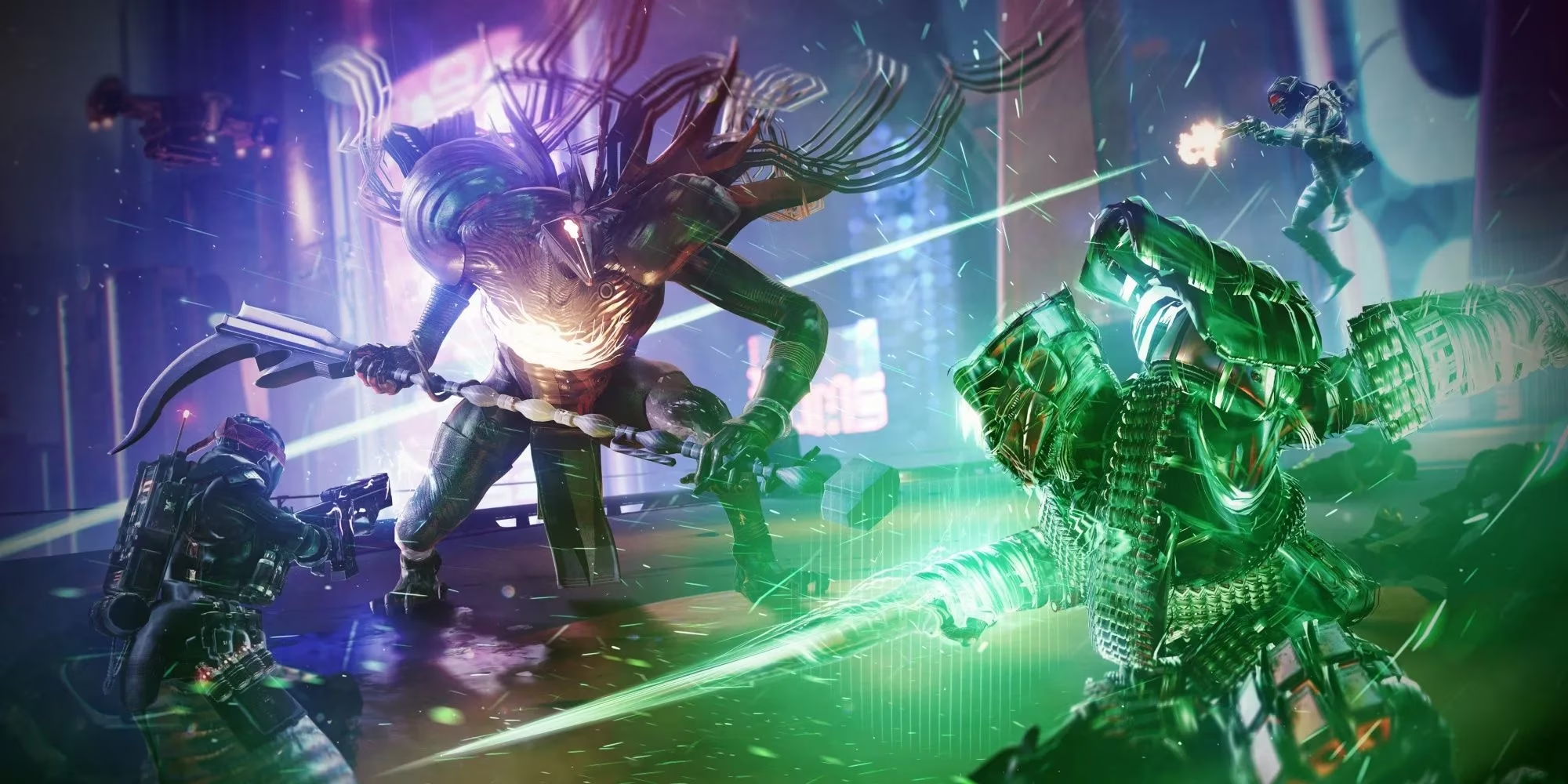
Yet, Bungie, in their infinite wisdom, had woven a quiet genius into the post-campaign grind. Unlocking Strand’s Fragments forced him to stick around. Slowly, piece by piece, the subclass revealed its hidden language. The Thread of Generation turned constant damage into a fountain of grapple energy. The Thread of Warding draped him in Woven Mail made from the very orbs he already craved. With the right Fragments, every Tangle became a rallying cry—exploding into unraveling projectiles, suspending entire battlegrounds, and feeding ability energy to his fireteam. The subclass stopped being an inefficient puzzle and started feeling like a dance.
It wasn’t that Strand suddenly outshone Solar. Even by 2026, after two years of balance patches and aspect tweaks, the fiery knives still claimed bigger numbers. But numbers, this Guardian discovered, weren’t the whole story. There was a moment in a Legendary campaign run, surrounded by Tormentors, where he didn’t calculate the optimal damage rotation. He just... swung. He grappled over a charging Incendior, slammed into the ground with an Ensnaring Slam that froze a dozen Scorn mid-lunge, and then yanked himself towards an exploding Tangle as if pulled by an invisible rope. He survived not because his build was superior, but because it was responsive. Strand made him feel like a conductor of chaos rather than a spreadsheet with a trigger finger.
This shift in mindset rippled outward. Strand’s entanglement verbs—Suspend, Unravel, and Sever—turned out to be a cooperation multiplier. He started noticing how a well-placed Threadling grenade could lock down a champion just long enough for a teammate to line up a rocket. Woven Mail let him revive allies in the thick of a GM with a confidence he’d never known. The subclass didn’t demand top-tier DPS; it offered a new toolset for creative problem-solving. The grapple, once derided as a gimmick, became the most expressive movement tool in the game—allowing him to bypass platforming puzzles, save himself from falling deaths, and literally pull allies out of danger. It felt like playing a different game.
The irony wasn’t lost on him. For years, he had chased the meta like a ghost chasing its unresolved trauma, constantly refining the build that would make the game as easy as possible. Strand did make the game easier in ways he hadn’t expected—not by deleting enemies faster, but by making failure less frustrating and success more thrilling. The cabal Phalanxes he once hid from became his personal marionette theater. Boss arenas transformed from static kill boxes into three-dimensional playgrounds. Even the much-maligned Silkstrike Super, which he initially wrote off as a poor man’s Golden Gun, became his favorite “delete button”—not for its raw damage, but for the dancelike rhythm of weaving through the air while skewering everything below.
Of course, Strand isn’t perfect. Hunters still grumble about the melee’s tracking, and Titans have had to weather endless nerfs to their beloved Banner of War builds. But the point isn’t whether Strand climbed the tier lists. The point is that it taught a hardened optimizer a new way to love Destiny 2. He still keeps his Solar and Void loadouts in his back pocket for the sweatiest Grandmasters. But when it’s time to farm dungeons, run seasonal activities, or just unwind in patrol zones, Strand is the subclass that calls to him. It’s not about being the best anymore; it’s about feeling the wind—and the Weave—in your face.
For Guardians still glued to the damage charts, the lesson is simple: sometimes the most powerful thing you can equip is a playstyle that makes you smile. Strand’s greatest gift isn’t suspension or unravel—it’s the freedom to forget the meta entirely. And in a game as vast as Destiny 2, maybe that’s the truest form of power.