Reflecting on Sony's Bungie Acquisition and Its Live Service Legacy
PlayStation's $3.6B Bungie acquisition kept Destiny 2 cross-play intact and fueled Sony's live service strategy.
I still remember the morning in January 2022 when the news broke: PlayStation was acquiring Bungie for $3.6 billion. It landed right after Microsoft's massive Activision Blizzard announcement, so the industry felt like it was shifting under my feet. For me, as someone who has played Destiny since the first game, the deal was personal. Bungie was not just another studio. It was the creator of a world I had spent hundreds of hours in, and now it was joining the PlayStation family. Five months later, the acquisition was finally completed. There had been rumblings that the US Federal Trade Commission probe would push the finalization into the next year, but it turned out to be standard procedure. By the time the deal closed, I felt a mix of excitement and caution.
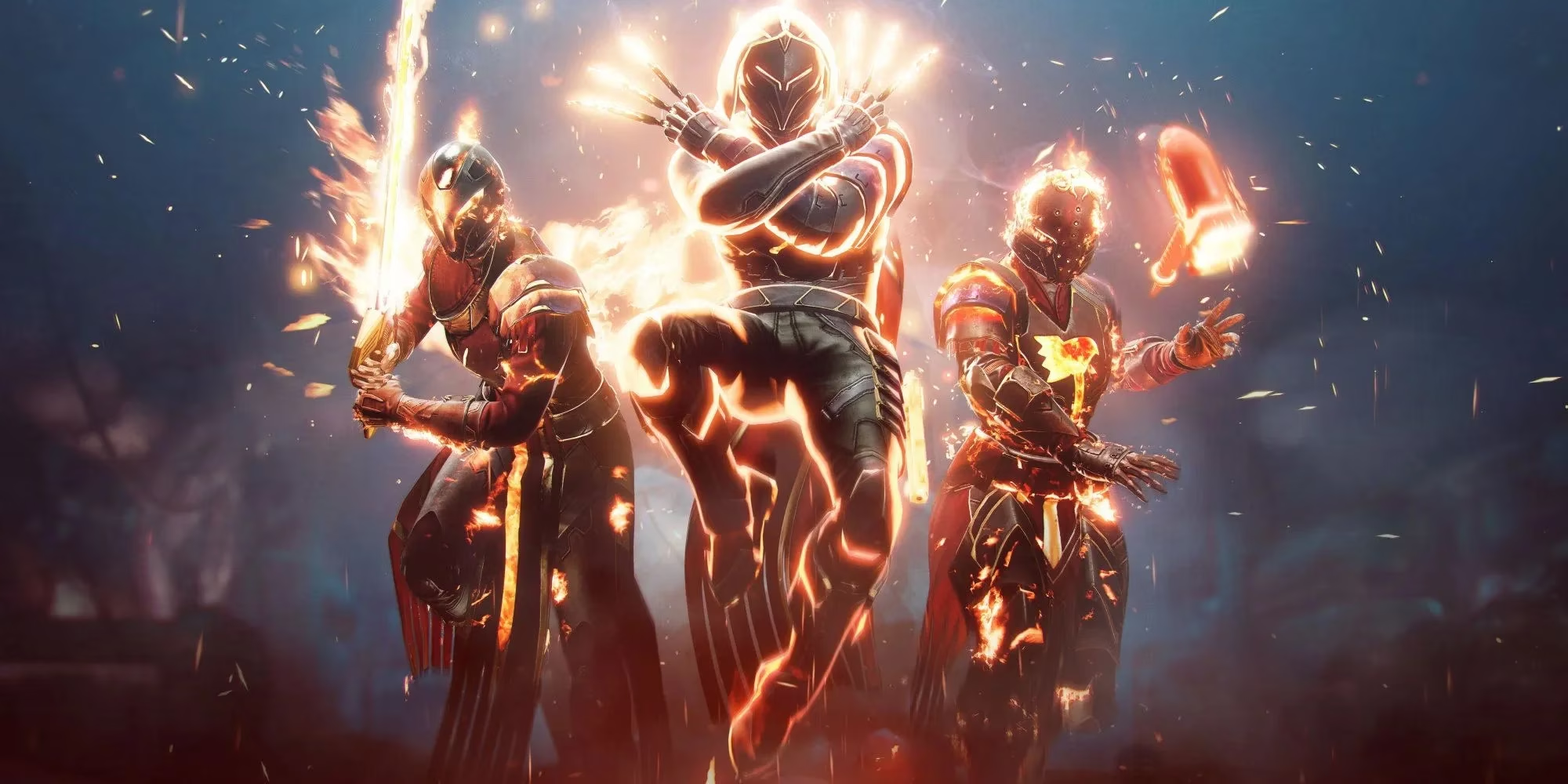
At the time, Bungie stressed that it remained committed to delivering the best experience to Destiny 2 players across all platforms. In an FAQ, the studio said its commitment to Destiny 2 as a multi-platform game with full Cross Play remained unchanged. It wanted players to play The Witch Queen on February 22, 2022, on the platform of their choice. It also wanted to maintain the same great experience players already had on their platform of choice. That reassurance mattered to me. I had friends on Xbox, PC, and PlayStation, and cross play was not a nice bonus; it was the reason our clan stayed together. The idea that the acquisition might fracture that community was my biggest fear. Bungie's words helped, but I knew the real test would come later.
What I did not fully appreciate at the time was how much Sony wanted Bungie for its live service expertise. Sony and Bungie were both looking to expand and improve upon the Destiny IP, but that was not the only reason for the acquisition. Bungie is one of the foremost studios in creating live service infrastructure. That knowledge would play a major role in a new internal department called the Live Service Center of Excellence. Sony detailed this in an investment report in May. Bungie would play a supporting role in the SIE framework, sharing its knowledge and expertise in the live service space with other studios within the PlayStation family. This was a major step for Sony, because the company planned to have a number of live service games up and running by 2025. Looking back from 2026, I can see how central that plan became. Live service games are now a huge part of the industry, and Bungie's fingerprints are all over Sony's approach.
Here is how I break down the key pieces of the story:
| Element | What happened | Why it mattered to me |
|---|---|---|
| Acquisition price | $3.6 billion | It showed how valuable Bungie's live service know-how had become |
| Announcement | January 2022 | It followed Microsoft's Activision Blizzard deal and changed the console landscape |
| Completion | Five months later | The FTC probe was standard procedure, not a roadblock |
| Platform promise | Destiny 2 remained multi-platform with full Cross Play | My clan could stay together across platforms |
| Live Service Center of Excellence | Bungie would support SIE studios | Sony was buying expertise, not just a game |
| Mobile project | Rumored unannounced FPS mobile game with NetEase | It hinted at Destiny's future beyond console and PC |
The Live Service Center of Excellence was a long-term plan, but in the more immediate future, Bungie appeared to be working on a mobile Destiny FPS. There was no official confirmation at the time. A report cited a NetEase employee's LinkedIn profile, which said they cooperated with Bungie in developing an unannounced FPS mobile game. The report also stated that a source with knowledge of NetEase's workings confirmed that Bungie had been working on such a game for over two years. I found that fascinating. Destiny's gunplay is some of the best in the business, and a mobile version could bring that feel to a new audience. But I also worried about the pitfalls of mobile live service games: monetization, touch controls, and the risk of splitting resources. If anyone could pull it off, Bungie could, but I did not want Destiny 2 to suffer because of it.
I also remember the conversation around Bungie's social causes. The studio has always stood up for social causes, and now it needed to stand by its trans employees. That line stuck with me because it reminded me that acquisitions are not just business deals. They affect the people who make the games I love. I hoped Bungie would keep its values even as it became part of a larger corporate structure. In 2026, that tension between creative independence and corporate ownership is still one of the biggest stories in gaming.
If I am honest, my feelings about the acquisition are still complicated. On one hand, I am glad Bungie has more resources. Destiny 2 is still a game I return to, and the cross play promise held. On the other hand, I miss the days when Bungie was fully independent. The $3.6 billion deal was a landmark moment, not just for Sony or Bungie, but for the entire industry. It showed that live service expertise was worth as much as a massive catalog of franchises. It also showed that platform holders were willing to spend big to secure that expertise. As I look ahead, I wonder what the next five years will bring. Will the mobile Destiny FPS finally launch? Will the Live Service Center of Excellence produce a hit? Will Bungie remain the studio I fell in love with? I do not have the answers, but I am still watching closely. After all, Destiny has always been about the journey, and this acquisition is just another chapter in a very long one.