The Crisis of Game Development: Why Talented Creators Are Leaving the Industry
The video game industry's systemic crisis of mass layoffs and developer instability starkly contrasts with the era of polished, expansive games, revealing a harsh disconnect between corporate profit motives and creative passion.
The video game industry in 2026 finds itself in a paradoxical state. On one hand, players have access to more polished, expansive, and visually stunning games than ever before. On the other, the very people who create these digital worlds are facing unprecedented instability, disillusionment, and career insecurity. The recent, massive layoffs at a major studio behind one of the world's most popular games, following a similar round of cuts just a year prior, have become emblematic of a systemic crisis. This pattern isn't isolated; it's the latest symptom of an industry where even legendary developers with decades of experience are not safe from abrupt termination, their dedication and craft rendered secondary to quarterly financial reports.
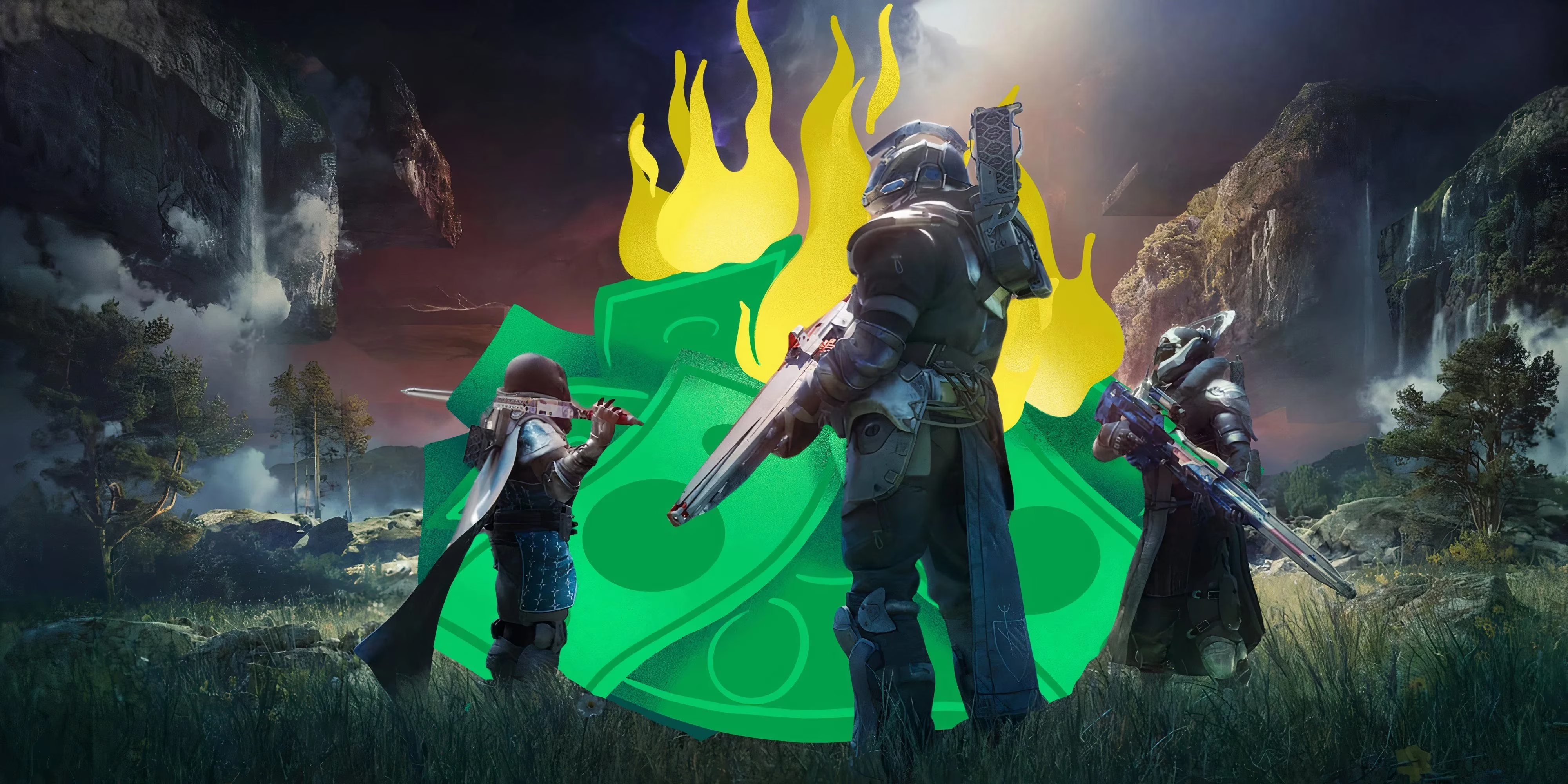
The romantic notion that people make games purely for the love of the art has been thoroughly weaponized. It's a mantra repeated to workers—the writers, artists, programmers, and designers—to justify lower pay, grueling crunch, and now, mass layoffs. Corporate executives, however, operate under no such illusion. Their decisions are driven by profit margins and shareholder returns, not a passion for compelling narratives or innovative mechanics. When a beloved studio is shuttered, it's not in pursuit of artistic purity or to ensure only "10/10 masterpieces" are released. It's a financial calculation. The dissonance is stark: the executives who make the high-risk financial decisions that lead to over-expansion and subsequent contraction rarely face personal consequences, while the developers who actually build the profitable products are the first to be cast adrift. This creates a perverse dynamic where the creators are punished for the miscalculations of the managers.
A common defense for these endless waves of job cuts points to macroeconomic factors: shifting interest rates, post-pandemic market corrections, or over-ambitious spending during lockdowns. While these are real pressures, they absolve the human decision-makers of responsibility. Financial blunders are framed as unavoidable natural disasters rather than the results of specific choices made by specific people in boardrooms. The follow-up questions are seldom asked: Who authorized that excessive spending? Who greenlit those unsustainable hiring sprees? The answer is almost never the narrative designer or the environment artist who is now packing their desk. Yet, it is these very workers who bear the brunt of the fallout, their livelihoods sacrificed to balance the books. This reality has led many to question the fundamental trade-off: Why dedicate your life to perfecting a creative craft in an industry that offers so little security in return?
For those witnessing the turmoil in AAA development, the indie scene might seem like a sanctuary. The success stories of solo developers or small teams creating breakout hits like Stardew Valley are powerful and inspiring. However, this path is fraught with its own severe challenges and is not a scalable solution for an entire workforce. The indie dream often requires a combination of immense personal savings, a supportive day job, or a financial safety net that many simply do not have. The reality is that most indie projects do not achieve financial sustainability, and the personal toll of years of uncertain, self-funded work can be immense. Furthermore, the indie scene is not immune to the consolidating forces of the larger industry. Successful small studios are frequently acquired by larger corporations, and the subsequent restructuring often leads to the same culture clashes and job losses seen elsewhere. The promise of creative freedom can quickly evaporate, leaving developers in a familiar position of instability, just with a different company logo on the severance paperwork.
-
Financial Precarity: Unlike more stable tech sectors, game dev salaries often don't compensate for the high risk of unemployment.
-
Lack of Labor Protections: In many regions, especially in the West, at-will employment is the norm, making layoffs swift and cheap for companies.
-
The Acquisition Trap: Indie success can lead to a buyout, which often results in studio dismantling for IP assets.
Beyond the economic insecurity lies another layer of occupational hazard: the relentless, often toxic, scrutiny from a fraction of the player base. Developers, particularly those in visible roles like character design or writing, are increasingly the targets of coordinated online harassment campaigns. These attacks can stem from the most trivial perceived slights—a character's design, a story beat, a piece of lore. While executives are insulated in corporate towers, the developers are on the front lines, their social media inboxes flooded with vitriol. This constant background noise of abuse, combined with the ever-present sword of Damocles that is a potential layoff, creates a uniquely stressful professional environment. It's a field where doing your job well can sometimes make you a target, and where your future is perpetually a "Riddler-sized question mark" due to unpredictable mergers and market shifts.

Given this landscape, a rational career calculus often points away from game development. A talented software engineer can find more stable, better-compensated work in fintech or enterprise software. A skilled artist can secure steady contracts in advertising or media. These fields may lack the glamour of working on the next big franchise, but they typically offer something the game industry frequently fails to provide: respect, stability, and a reasonable expectation that your job will still exist next quarter. The industry's reliance on passion as a currency is depleting its talent pool. Why would a rational person choose a path of excitement coupled with constant terror when alternatives offer boredom paired with security, especially for those with families or financial obligations?
This is not to say every studio is a dystopian workplace. There are companies, both in Japan—where stronger labor laws offer protection—and in the West, that foster loyalty, avoid mass layoffs, and treat their employees well. However, they remain the exception rather than the rule. The prevailing culture in too many corners of the industry is one of disposability. It's a revolving door where inexperience is punished with a lack of support, and valuable experience is punished with a higher salary that makes an employee a cost-cutting target. This cycle wastes immense talent and institutional knowledge, ultimately diminishing the quality of the games themselves. The human cost is immense, with seasoned creators leaving the field entirely, taking their expertise with them.
The solution, while complex, must involve structural change. The growing movement toward unionization is one of the most significant developments. Unions cannot make layoffs impossible, but they can establish due process, secure better severance, and make reckless firings for short-term stock bumps a more difficult and expensive proposition. They provide a collective voice to push back against the worst excesses of crunch culture and job insecurity. Furthermore, a shift in industry mindset is required—from seeing developers as interchangeable, passion-fueled cogs to valuing them as the irreplaceable core asset they are. The games that generate billions in revenue do not code, write, or design themselves. The people who do that work deserve compensation and job security that reflects their critical contribution to the bottom line.
In 2026, we should be astonished that anyone with talent and options still chooses to make video games. The industry has spent the last few years consuming and discarding some of its brightest minds. Those who remain shouldn't be considered the "lucky ones" who must tolerate poor conditions out of fear. They deserve to work in an environment where making a video game is the cool, collaborative, and respected endeavor it should be, not a nightmare oscillating between periods of unsustainable crunch and the anxiety of impending unemployment. The future of the medium depends on it.